Blood Glucose Index vs. Glycemic Load is an important concept for anyone seeking steady energy levels, better blood sugar control, and improved athletic performance. Have you ever eaten a meal before working out and felt an initial burst of energy, only to experience a sudden crash? Or perhaps after a carb-heavy meal, you felt sleepy instead of energized? Understanding how different carbohydrates affect your body can help explain these common experiences.
This is where understanding the difference between the Blood Glucose Index (GI) and Glycemic Load (GL) becomes crucial. A surface-level understanding of carbs won’t suffice if your goal is sustained energy, stable blood sugar levels, and consistent physical performance.
In this first part, we’ll break down these two concepts in simple terms and explore how each affects your blood sugar, focus, and athletic output.
What Is the Blood Glucose Index?
A simple definition:
The Glycemic Index (GI) measures how quickly a specific food raises blood glucose compared to pure glucose.
-
- High GI foods → spike blood sugar rapidly
- Low GI foods → raise blood sugar gradually
Examples:
-
- White bread → high GI
- Oats → low GI
But here’s the catch: GI alone doesn’t tell the full story, which is why we need to look at glycemic load.

Blood Glucose Index vs. Glycemic Load: Why GI Alone Isn’t Enough?
Imagine eating watermelon. Its GI is relatively high, yet does that mean it will drastically spike your blood sugar? Not necessarily. GI measures speed, not quantity of carbs.
That’s where glycemic load comes in.
What Is Glycemic Load in the Blood Glucose Index vs. Glycemic Load Comparison?
Glycemic Load (GL) accounts for:
-
- How quickly a food raises blood sugar (GI)
- The actual amount of carbs in a serving
This makes GL a more precise measure of a food’s real impact.
Watermelon again:
Although it has a high GI, a typical serving contains relatively few carbs—so its GL is low.
Understanding both GI and GL gives you a clearer picture instead of judging foods by GI alone.

How Does This Affect Athletic Energy?
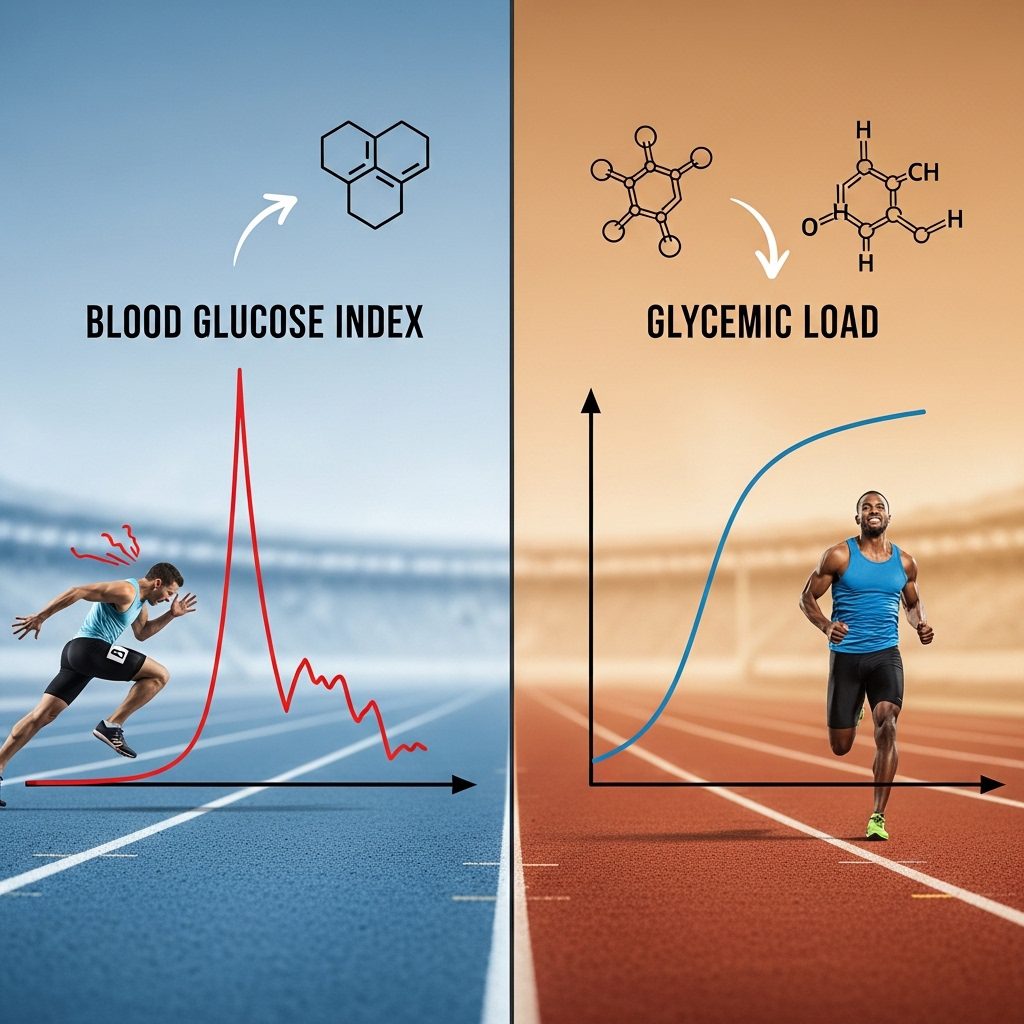
Eating high-GL foods before a workout can:
-
- Spike blood sugar quickly
- Trigger a large insulin release
- Lead to a sudden energy drop
In contrast, choosing low-to-moderate GL foods can:
-
- Raise blood sugar gradually
- Provide sustained energy
- Reduce the risk of sudden crashes
This distinction is particularly important for athletes seeking consistent performance.
Blood Glucose Index vs. Glycemic Load: When Is High GI Beneficial?
Not all blood sugar spikes are bad.
Immediately after intense exercise, high-GI carbs can be useful to quickly replenish glycogen stores.
So the question isn’t “good or bad”, it’s “when and how much”.
Focusing solely on GI can be misleading—combining it with GL provides real control over your energy and performance.

Practical Strategies for Sustained Energy:
1. Pre-Workout Fuel:
If your workout is an hour or more away, choose moderate-GL options:
-
- Oatmeal with fruit
- Whole-grain bread with protein
- Boiled potatoes with eggs
These provide gradual, stable energy.
If your workout is within 30 minutes, small, fast-digesting carbs can be appropriate in limited amounts.
The key: understanding GI vs. GL helps you avoid sudden energy drops.
2. Stabilizing Blood Sugar Throughout the Day:
Frequent blood sugar swings can affect:
-
- Focus
- Mood
- Appetite
- Physical performance
Tips:
-
- Pair carbs with protein
- Include fiber
- Avoid large amounts of refined sugars
This helps maintain steady energy even if some foods have a higher GI.
3. Post-Workout Recovery:
After intense exercise, higher-GI carbs can speed glycogen replenishment, especially if you have another session later in the day.
Quantity still matters—this is where GL guides smarter choices.

Blood Glucose Index vs. Glycemic Load: Do You Need to Calculate Everything?
Not necessarily. The goal isn’t to turn your life into formulas. Instead:
-
- Understand the principles
- Make informed choices
- Observe how your body responds
Your body sends clear signals:
-
- Stable energy? Smart choice
- Frequent crashes? Adjust carb type or portion
For reliable, science-based information on the glycemic index and its health effects, check the NIH resource.
Your Daily Energy Is Your Choice:
Understanding GI vs. GL isn’t about restriction—it’s about empowerment.
Control your blood sugar, and you control your energy, focus, and athletic performance.
If you want to dive deeper into smart nutrition strategies or explore how lifestyle and travel influence health and performance, visit nutritiontravels.
Knowledge fuels energy… and today’s energy powers tomorrow’s performance.